Exercise library / Back
Seated cable row
Back · Cable
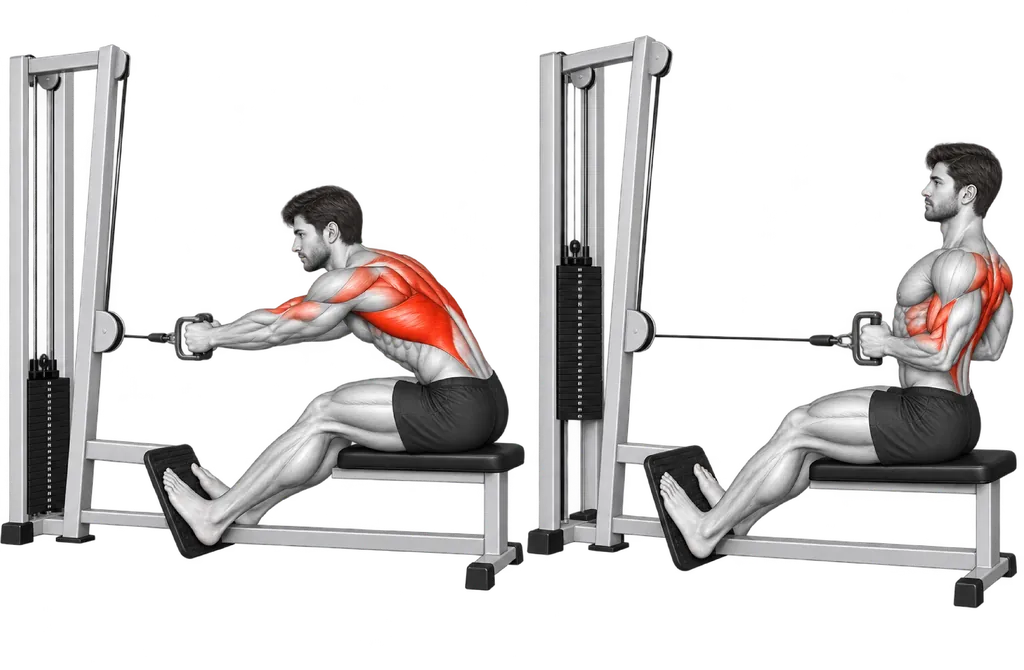
The seated cable row is the horizontal pull where you can concentrate on your back without your lower back being the limit. Your chest is not supported, but your legs and hips brace you and you sit still.
That makes it the most user-friendly back exercise there is, and also the easiest to cheat. The rocking creeps in as the weight climbs.
Sets, reps and RIR
Machines and cables hold the path for you, so you can work closer to failure than with free weights.
RIR means reps in reserve: how many you could still have done when you racked it. RIR 2 is two short of failure.
How to do it
- Put your feet on the platform with a slight knee bend and sit up tall.
- Lean forward to take the handle, then sit up to vertical before you start pulling.
- Begin by depressing and retracting the shoulder blades.
- Pull the handle to your navel with the elbows close to your body.
- Keep the torso vertical at the top. No leaning back.
- Let it forward until the arms are straight and the shoulders stretch, without rounding your back.
Common mistakes
- Rocking back and forth
- Using your torso as a pump means the hip joint is moving the weight. Take off a couple of plates and sit still.
- Pulling with the arms
- If you feel it mostly in the biceps, the pull started at the elbow. Shoulder blades first.
- Rounding the back on the way forward
- The stretch belongs in the shoulder blades, not the lower back. Keep the spine neutral and let the shoulders travel.
- Elbows flared out
- That moves work to the rear delts. Not wrong in itself, but then it is a different exercise from the one you thought you were doing.
How it differs from the neighbouring variants
The barbell row loads heavier and trains the lower back that holds you up, but the lower back is also what fails first. The cable row lets you train the back hard without that cost.
The single-arm cable row gives a longer range and exposes side-to-side differences. The chest-supported machine row removes even more of the lower back. The lat pulldown pulls vertically instead of horizontally, reaching the lats more and the mid-back less. A complete back session has one of each direction.
What it suits
The seated cable row fits in the middle of a back session, after a heavy pull and before isolation work. Eight to twelve reps with a one-second squeeze works well. It is also the right pick on a day when your lower back has already had enough.
Muscles worked
Primary: Lats, Upper back.
Secondary: Biceps, Rear delts, Rotator cuff.
Estimate your one-rep max
Epley's formula, from a set you have actually done. It is an estimate, and it drifts above eight reps, so keep the input between one and twelve.
Enter a set to see the estimate.
What it is called elsewhere
- Norsk Sittende kabelroing
- Svenska Sittande kabelrodd
- Dansk Siddende kabelroning
- Deutsch Rudern am Kabelzug sitzend
- Español Remo sentado en polea
- Italiano Pulley basso da seduto
- Português Remada baixa (polia)
- Русский Тяга нижнего блока сидя
- Français Tirage horizontal assis
Related back exercises
athlate logs this exercise, keeps the numbers, and tells you what you lifted last time.