Exercise library / Back
Barbell row
Back · Barbell
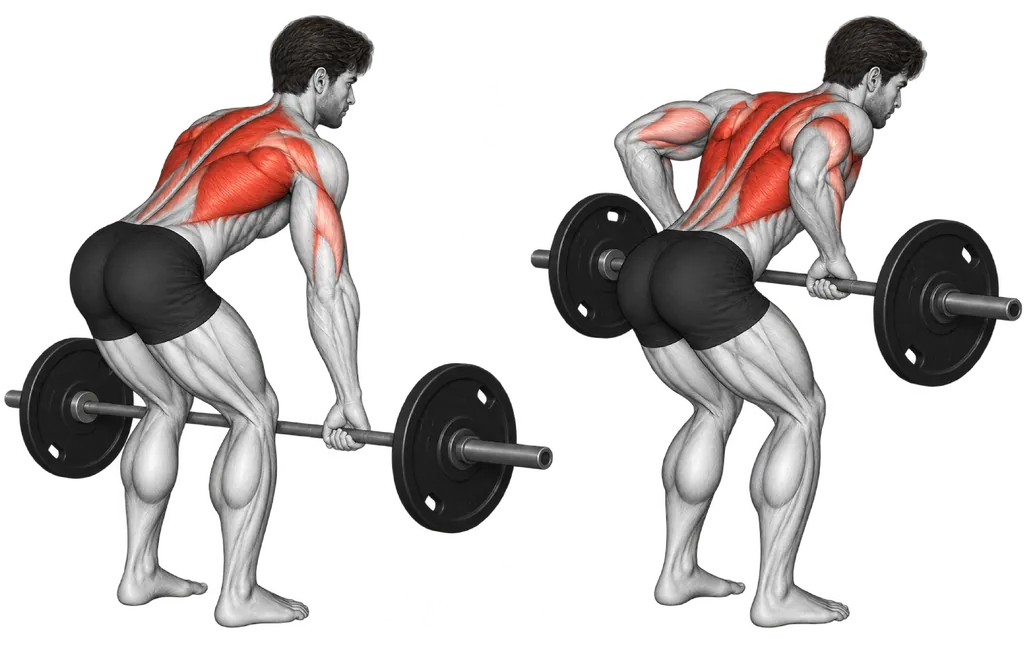
The barbell row is the heaviest horizontal pull you can do, and the only one where your lower back holds you up for the whole set. That is both its strength and its weakness.
Done well it builds mid-back and lats in a way no machine matches. Done badly it is just a poor isometric for your lower back.
Sets, reps and RIR
A heavy multi-joint lift with free weights. Keep a rep or two in reserve on most sets so technique holds.
RIR means reps in reserve: how many you could still have done when you racked it. RIR 2 is two short of failure.
How to do it
- Stand with feet hip width and grip the bar just outside shoulder width.
- Hinge at the hips until your torso is around forty-five degrees, knees softly bent.
- Brace and lock that torso angle. It should not change while you row.
- Pull the bar to your navel or lower ribs, elbows close to the body.
- Squeeze the shoulder blades together at the top without jerking the torso.
- Lower under control until the arms are straight and the shoulders stretch forward.
Common mistakes
- Torso rising on every rep
- Starting at forty-five degrees and finishing at seventy means the weight took over. It is the most common fault in the lift.
- Driving with the hips
- Using hip extension to get the bar up makes it half a clean. Drop the load until your back can do the pull on its own.
- Elbows flared straight out
- That moves the work to the rear delts and away from the lats. Keep the elbows in when you pull to the navel.
- Lower back failing before the back does
- That is a real limit of the exercise, not a fault you can think your way out of. Switch to a chest-supported variant when it happens.
How it differs from the neighbouring variants
The Pendlay row resets the bar on the floor between reps, which removes any borrowed momentum and forces a fresh dead pull each time. It is stricter and harder on the lower back.
The T-bar row gives the same direction with better balance and lets you go heavier. The chest-supported dumbbell row and the seal row take the lower back out entirely, which is the right call when you want to train the back hard without spending the lower back you need for deadlifts later that week. The single-arm dumbbell row gives the longest range of them all.
What it suits
The barbell row belongs first or second in a back session, while your lower back is fresh. If you deadlift the same week, do not put them on consecutive days, because they draw on the same thing.
Muscles worked
Primary: Lats, Upper back.
Secondary: Biceps, Rear delts, Lower back, Rotator cuff.
Estimate your one-rep max
Epley's formula, from a set you have actually done. It is an estimate, and it drifts above eight reps, so keep the input between one and twelve.
Enter a set to see the estimate.
What it is called elsewhere
- Norsk Roing med stang
- Svenska Skivstångsrodd
- Dansk Roning med vægtstang
- Deutsch Langhantelrudern
- Español Remo con barra
- Italiano Rematore con bilanciere
- Português Remada curvada (barra)
- Русский Тяга штанги в наклоне
- Français Rowing barre
Related back exercises
- Single-arm dumbbell row
- Chest-supported dumbbell row
- DB pullover
- Shrugs (dumbbells)
- Romanian deadlift (dumbbells)
- Seal row
athlate logs this exercise, keeps the numbers, and tells you what you lifted last time.