Exercise library / Back
Deadlift (barbell)
Back · Barbell
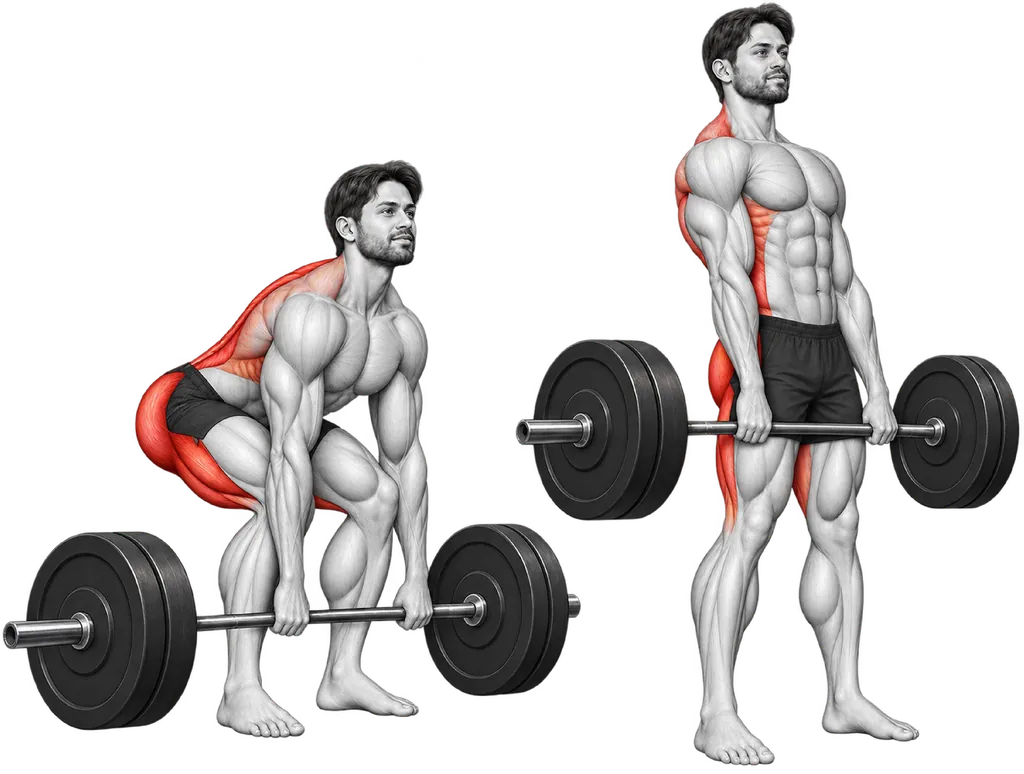
The deadlift is the one lift that starts from a dead stop every rep. That makes it honest: you cannot borrow speed from a lowering phase, and a bad start never becomes a good rep.
It is also the lift that costs you most. Two or three hard sets a week is enough for most people, and more than that eats the recovery the rest of the programme needs.
Sets, reps and RIR
A heavy multi-joint lift with free weights. Keep a rep or two in reserve on most sets so technique holds.
RIR means reps in reserve: how many you could still have done when you racked it. RIR 2 is two short of failure.
How to do it
- Set the bar over the middle of your foot, not against your shin and not out by your toes.
- Hinge at the hips until your hands reach the bar, gripping just outside your legs.
- Drop the hips until your shins touch the bar, then lift the chest without letting the hips sink further.
- Pull the slack out of the bar and hold that tension for half a second before the weight leaves the floor.
- Push the floor away and keep the bar against your legs the whole way up.
- Lock out by squeezing the glutes, not by leaning back. Return the bar down the same path.
Common mistakes
- Jerking the start
- Slack in your arms and in the bar means your back takes the hit before your legs get to work. Take the slack out first, then lift.
- Hips too low
- It looks like a squat with a bar in your hands, and then the bar has to travel around your knees. The hips start higher than in a squat.
- Bar drifting forward
- Every centimetre away from you is extra work for your lower back. Think about scraping the bar up your shins.
- Hyperextending at the top
- Leaning back at lockout loads the spine and adds nothing to the lift. Stop when your hips are straight.
How it differs from the neighbouring variants
The Romanian deadlift starts at the top and only goes down to a stretch in the hamstrings. It trains the posterior chain harder per kilo and costs you less, so it is easier to run more than once a week.
Sumo shifts work from the lower back to the hips and inner thighs, and suits many people with a long torso. The trap bar puts the load around you instead of in front of you, which keeps the torso upright and makes it the safest place to start if you are new. The rack pull cuts the bottom of the range when the floor is the part giving you trouble.
What it suits
The deadlift goes first in the session, and preferably not the day before a heavy leg day. If your lower back complains, move to the trap bar or dumbbell Romanian deadlifts before you drop the lift entirely. Always log which variant you used, or you end up comparing numbers that do not belong together.
Muscles worked
Primary: Lower back, Glutes, Hamstrings.
Secondary: Traps, Lats, Forearms, Quads.
Estimate your one-rep max
Epley's formula, from a set you have actually done. It is an estimate, and it drifts above eight reps, so keep the input between one and twelve.
Enter a set to see the estimate.
What it is called elsewhere
- Norsk Markløft (stang)
- Svenska Marklyft (skivstång)
- Dansk Dødløft (vægtstang)
- Deutsch Kreuzheben (Langhantel)
- Español Peso muerto (barra)
- Italiano Stacco da terra (bilanciere)
- Português Levantamento terra (barra)
- Русский Становая тяга со штангой
- Français Soulevé de terre (barre)
Related back exercises
- Single-arm dumbbell row
- Chest-supported dumbbell row
- DB pullover
- Shrugs (dumbbells)
- Romanian deadlift (dumbbells)
- Seal row
athlate logs this exercise, keeps the numbers, and tells you what you lifted last time.