Exercise library / Back
T-bar row
Back · Barbell
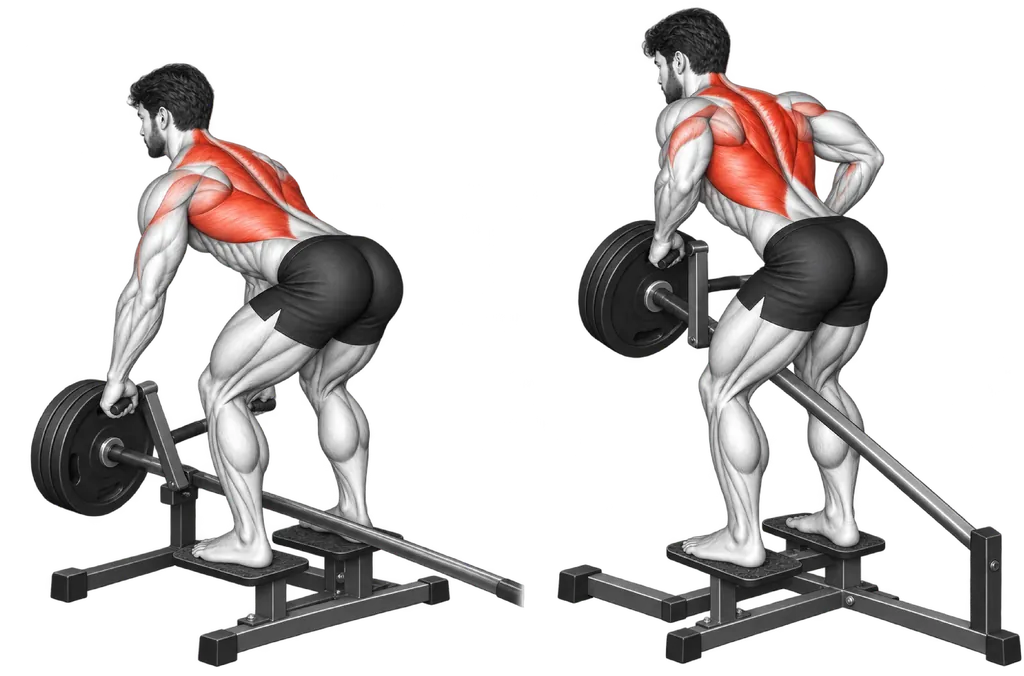
The T-bar row is a horizontal pull where one end of the bar is anchored, so the bar swings in an arc instead of straight up. Most gyms have either a chest-supported version or a landmine setup you stand over.
The supported version is the reason to choose it. With the chest on a pad, the lower back is not holding the torso angle, so the row lasts as long as the back muscles do.
Sets, reps and RIR
A heavy multi-joint lift with free weights. Keep a rep or two in reserve on most sets so technique holds.
RIR means reps in reserve: how many you could still have done when you racked it. RIR 2 is two short of failure.
How to do it
- Set your chest against the pad, or straddle the bar with a hip hinge and a flat back if the machine is unsupported.
- Take the handles with a neutral or overhand grip, arms straight, shoulders reaching forward slightly at the bottom.
- Start the pull by moving the shoulder blades back and together, before the elbows bend.
- Pull the handles to the lower ribs, elbows close to the body if you want lats, wider if you want mid-back.
- Hold for a beat, then let the weight straighten your arms and pull your shoulder blades forward again.
Common mistakes
- Starting with the arms
- If the elbows bend before the shoulder blades move, the biceps run the set and the back gets the leftovers.
- Lifting the chest off the pad
- The pad is the whole point. Coming off it means the weight is too heavy and the lower back is back in the exercise.
- Short range at the bottom
- Letting the shoulder blades travel forward at the bottom is what gives the mid-back something to work through. Do not stop with the arms half-bent.
- Jerking the hips on the unsupported version
- Standing T-bar rows drift into a partial deadlift quickly. If your hips move, the set is over.
How it differs from the neighbouring variants
The barbell row loads more of the whole posterior chain because you hold the torso angle yourself, which also means the lower back often quits first. The T-bar row removes that limit when it is chest-supported.
The seated cable row is the same pull from a seated position with constant tension and an easier setup. The single-arm dumbbell row lets each side work on its own and gives the longest range of the four.
What it suits
T-bar rows fit as the first or second back exercise, and they are especially useful on a day that already had deadlifts or squats, because the lower back is not the limit. Six to twelve reps, one or two in reserve.
Muscles worked
Primary: Lats, Upper back.
Secondary: Biceps, Rear delts, Rotator cuff.
Estimate your one-rep max
Epley's formula, from a set you have actually done. It is an estimate, and it drifts above eight reps, so keep the input between one and twelve.
Enter a set to see the estimate.
What it is called elsewhere
- Norsk T-bar roing
- Svenska T-bar rodd
- Dansk T-bar roning
- Deutsch T-Bar Rudern
- Español Remo en T
- Italiano Rematore T-bar
- Português Remada cavalinho
- Русский Тяга Т-грифа
- Français Rowing T-bar
Related back exercises
- Single-arm dumbbell row
- Chest-supported dumbbell row
- DB pullover
- Shrugs (dumbbells)
- Romanian deadlift (dumbbells)
- Seal row
athlate logs this exercise, keeps the numbers, and tells you what you lifted last time.