Exercise library / Back
Shrugs (barbell)
Back · Barbell
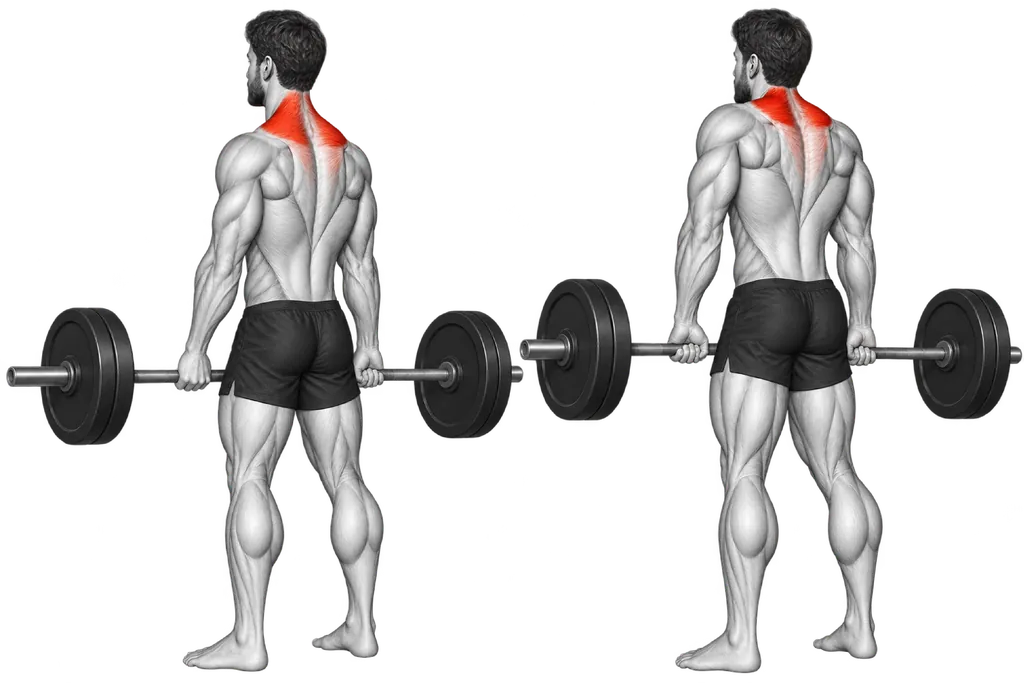
A shrug lifts the shoulder blade towards the ear. That is the whole movement, and it is the upper trapezius doing almost all of it.
The range is short, which fools people into thinking the exercise is about the weight. It is not. A shrug done with a real range and a pause at the top with 60 kg beats a 140 kg twitch every time.
Sets, reps and RIR
A heavy multi-joint lift with free weights. Keep a rep or two in reserve on most sets so technique holds.
RIR means reps in reserve: how many you could still have done when you racked it. RIR 2 is two short of failure.
How to do it
- Hold a barbell in front of your thighs with your hands a little wider than your hips and your arms straight.
- Stand tall with the ribs down, and let the shoulders hang. That is the bottom of the rep.
- Lift the shoulders straight up towards the ears, as high as they go.
- Hold at the top for a beat so the muscle works in the shortened position instead of bouncing through it.
- Lower all the way down and let the shoulders hang again before the next rep.
Common mistakes
- Rolling the shoulders
- Circling backwards adds nothing the traps can use and puts the shoulder joint through a loaded rotation at the least helpful moment. Straight up, straight down.
- A three-centimetre range
- When the weight is too heavy the shoulders barely move and the set becomes a holding exercise. Take enough off the bar that the top and the bottom are visibly different positions.
- Bending the elbows
- Once the arms pull, this is an upright row and the work moves to the delts. Arms stay straight, hanging like straps.
- Pushing the chin forward
- Poking the head forward to meet the shoulders makes the rep look bigger. Keep the neck where it was and let the shoulders travel.
How it differs from the neighbouring variants
Dumbbell shrugs hang at your sides instead of in front, which gives a slightly longer range and lets the shoulders sit in a more natural line. The barbell lets you load more.
A trap bar puts the load in line with your body and is the most comfortable version for most people. Cable shrugs keep tension at the top, where the barbell version is at its easiest.
What it suits
Shrugs sit at the end of a pull session or a shoulder session. Eight to fifteen reps with one or two in reserve works well. If your grip fails before your traps do, use straps. The point of the exercise is the trapezius, and letting the forearms decide the set is the one thing that makes it useless.
Muscles worked
Primary: Traps.
Secondary: Forearms.
Estimate your one-rep max
Epley's formula, from a set you have actually done. It is an estimate, and it drifts above eight reps, so keep the input between one and twelve.
Enter a set to see the estimate.
What it is called elsewhere
- Norsk Shrugs (stang)
- Svenska Shrugs (skivstång)
- Dansk Shrugs (vægtstang)
- Deutsch Schulterheben (Langhantel)
- Español Encogimientos (barra)
- Italiano Scrollate (bilanciere)
- Português Encolhimento de ombros (barra)
- Русский Шраги со штангой
- Français Shrugs (barre)
Related back exercises
- Single-arm dumbbell row
- Chest-supported dumbbell row
- DB pullover
- Shrugs (dumbbells)
- Romanian deadlift (dumbbells)
- Seal row
athlate logs this exercise, keeps the numbers, and tells you what you lifted last time.