Exercise library / Back
Pull-ups
Back · Bodyweight
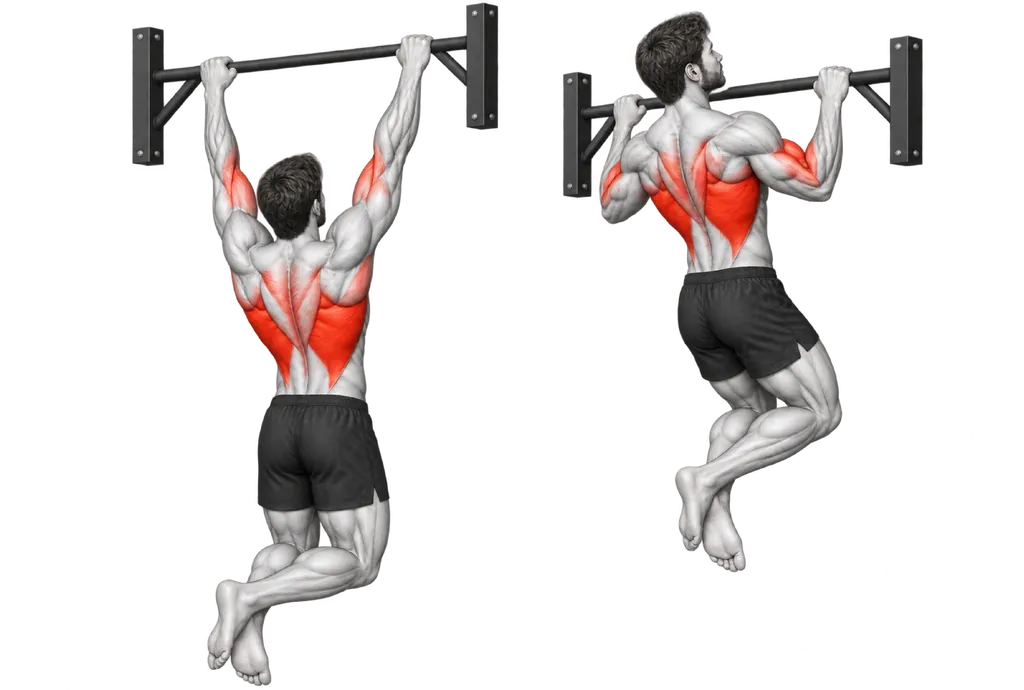
The pull-up draws the clearest line in the gym: either you can do one or you cannot. There is no lighter weight to start with, which is why most people skip them.
The answer is not to wait until you are strong enough. It is to train the movement itself with less resistance, on an assisted machine, with a band, or by lowering yourself slowly from the top.
Sets, reps and RIR
Load is fixed, so progress by adding reps first, then by slowing the lowering phase, then by adding weight.
RIR means reps in reserve: how many you could still have done when you racked it. RIR 2 is two short of failure.
How to do it
- Grip the bar slightly wider than shoulder width, palms facing away.
- Hang with straight arms and pull the shoulder blades down before you bend the elbows at all.
- Drive the elbows down towards your ribs and think about pulling the bar to you rather than pulling yourself up.
- Rise until your chin clears the bar, without throwing your head back to get there.
- Lower under control until the arms are straight again. A full hang between reps, not a half one.
Common mistakes
- Kicking with the legs
- Kipping is a different exercise with a different purpose. To build back, keep the legs quiet and cross them behind you.
- Stopping short of a straight arm
- The bottom of the range is where the lats do most of their work. Cut it and you are training only the top of the movement.
- Shoulders up by the ears at the bottom
- Hanging completely loose turns the first part of the pull into a jerk. Set the shoulder blades before you pull.
- Too many sets to failure
- Pull-ups are easy to overdo because they feel free. Two or three sets with a rep or two left beats five sets to failure.
How it differs from the neighbouring variants
Chin-ups turn the palms towards you, give the biceps more to do, and most people get two or three more reps. If your goal is the first rep, start there.
The lat pulldown is the same pulling pattern with a weight you can pick kilo by kilo, which makes it better for slow progression and higher reps. The assisted pull-up machine sits closest to the real thing, because you still have to hold your body in position. Once you clear ten good reps, weighted pull-ups are the next step rather than more reps.
What it suits
Pull-ups go first in a back session, while your grip is fresh. If you can do none, run three to five negatives taking five seconds to lower, twice a week. Most people get their first rep within a few weeks of that.
Muscles worked
Primary: Lats.
Secondary: Biceps, Upper back, Rotator cuff.
What it is called elsewhere
- Norsk Pull-ups
- Svenska Chins
- Dansk Pull-ups
- Deutsch Klimmzüge
- Español Dominadas
- Italiano Trazioni alla sbarra
- Português Barra fixa
- Русский Подтягивания
- Français Tractions
Related back exercises
athlate logs this exercise, keeps the numbers, and tells you what you lifted last time.