Exercise library / Back
Lat pulldown
Back · Cable
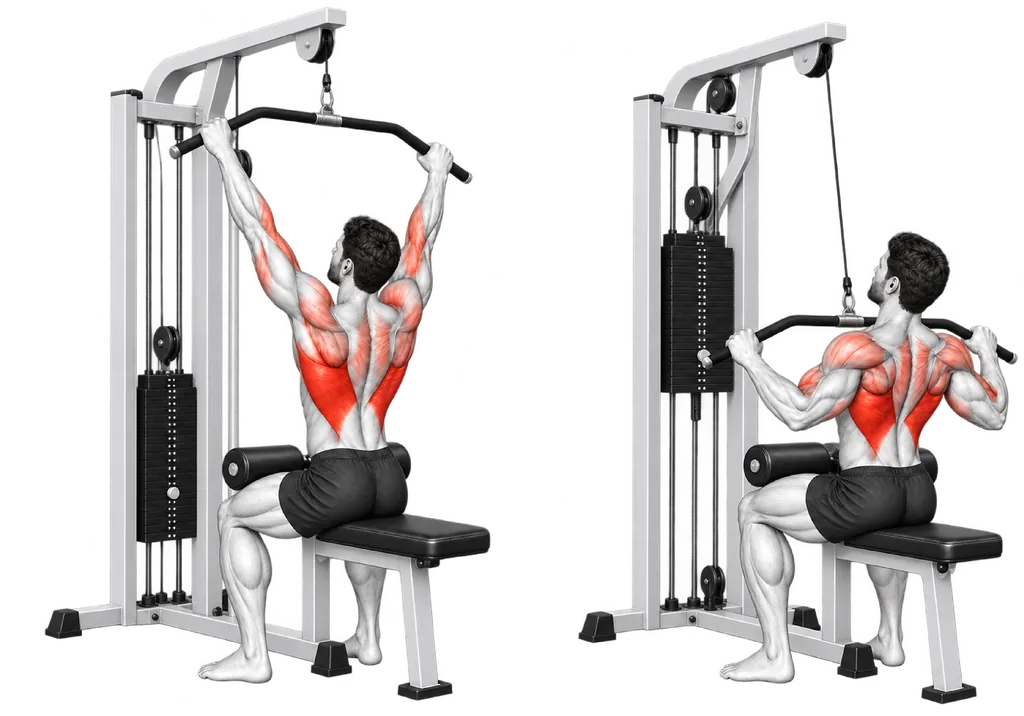
The lat pulldown is the exercise most people do with their biceps. The movement looks right, the bar comes down, and the lats barely took part.
What is good about it is that you pick the weight kilo by kilo. That makes it the best place to build pulling strength slowly, and the obvious choice if you cannot do pull-ups yet.
Sets, reps and RIR
Machines and cables hold the path for you, so you can work closer to failure than with free weights.
RIR means reps in reserve: how many you could still have done when you racked it. RIR 2 is two short of failure.
How to do it
- Set the thigh pad tight enough that your hips stay down when you pull.
- Grip the bar slightly wider than shoulder width, thumb wrapped.
- Lean back about ten to twenty degrees and stay there. That angle should not change during the set.
- Start the pull by depressing the shoulder blades, before the elbows bend.
- Pull the bar to the upper chest, elbows driving down towards your ribs.
- Let it back up under control until the arms are straight and the shoulders stretch, without losing your brace.
Common mistakes
- Pulling with the arms
- If you only feel it in your biceps, the pull started at the elbow. Drop the shoulder blades first and let the arms follow.
- Rocking the torso
- Leaning further back on every rep means the weight is deciding, not you. Lock the angle and drop a couple of kilos.
- Bar behind the neck
- That version adds nothing and puts the shoulder in a position it is not built for. Pull to the chest.
- Stopping short at the top
- The top of the range is where the lats stretch most. Cut it and you are training the middle only.
How it differs from the neighbouring variants
Pull-ups are the same movement with body weight, and they ask you to hold your whole body in position as well. The pulldown wins on progression, the pull-up wins on strength that carries over.
The close-grip pulldown tucks the elbows in and gives the biceps and lower lats more to do. The seated cable row pulls horizontally instead of vertically, hitting the mid-back and rhomboids more than the lats. They complement each other, and most back sessions have room for both.
What it suits
The pulldown belongs early in a back session if you are not doing pull- ups, or straight after them if you are. It is also the right pick when you want higher-rep volume without your grip failing first.
Muscles worked
Primary: Lats.
Secondary: Biceps, Upper back, Rotator cuff.
Estimate your one-rep max
Epley's formula, from a set you have actually done. It is an estimate, and it drifts above eight reps, so keep the input between one and twelve.
Enter a set to see the estimate.
What it is called elsewhere
- Norsk Lat pulldown
- Svenska Latsdrag
- Dansk Lat pulldown
- Deutsch Latzug
- Español Jalón al pecho
- Italiano Lat machine
- Português Puxada frontal
- Русский Тяга верхнего блока к груди
- Français Tirage vertical (poulie haute)
Related back exercises
athlate logs this exercise, keeps the numbers, and tells you what you lifted last time.