Exercise library / Legs
Lunges (dumbbells)
Legs · Dumbbells
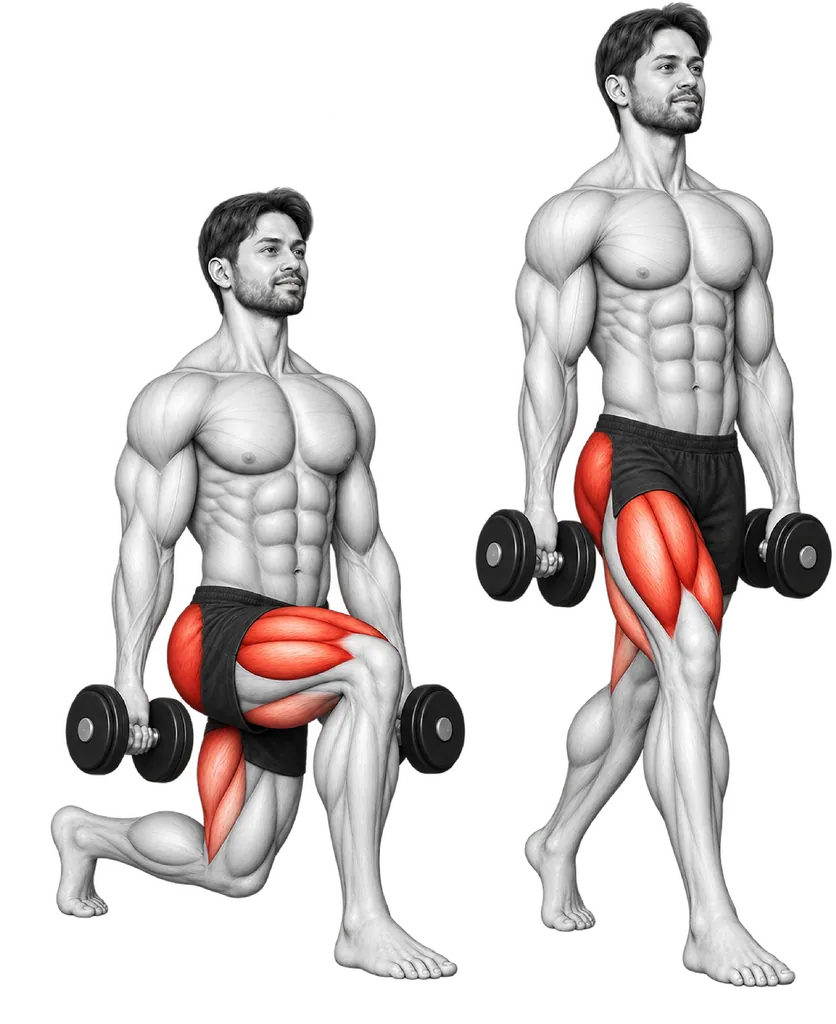
The lunge is the leg exercise that most resembles something you actually do: climbing stairs, standing up from a crouch, taking a long stride. One leg carries, the other balances.
Step length decides what you train. A long step gives glutes and hamstrings, a short step gives quads. Neither is wrong, but they are not the same.
Sets, reps and RIR
A heavy multi-joint lift with free weights. Keep a rep or two in reserve on most sets so technique holds.
RIR means reps in reserve: how many you could still have done when you racked it. RIR 2 is two short of failure.
How to do it
- Stand with a dumbbell in each hand, arms straight down at your sides.
- Step forward, far enough that the front shin is roughly vertical at the bottom.
- Lower straight down until the back knee nearly touches the floor.
- Keep the torso upright, weight through the whole front foot.
- Drive off the front heel back to the start.
- Alternate legs, or finish all reps on one leg at a time.
Common mistakes
- Step too short
- The knee shoots well past the toes and the load lands on the patellar tendon. This is the most common reason people say lunges hurt their knees.
- Torso falling forward
- With heavy dumbbells it quickly becomes a single-leg good morning. Keep the chest up.
- Back knee banging the floor
- Using the floor as a bottom stop is hard on the kneecap. Stop a centimetre short.
- Stepping onto a line
- Placing the foot in line with the other turns it into a balance beam. Step at hip width.
How it differs from the neighbouring variants
Walking lunges add travel and make the exercise more demanding on your conditioning and balance. Stationary lunges let you go heavier and are easier to log identically week to week.
The Bulgarian split squat puts the back foot on a bench, removing the rear leg's help and making the front leg work far harder. Barbell lunges let you load more but make balance harder. The curtsy lunge steps diagonally back and hits the outer glute more.
What it suits
Lunges fit as the second or third leg exercise, at eight to twelve reps per leg. They are also a good choice on a session without a rack, since two dumbbells are all you need. Done walking, expect your breathing to stop you before your legs do.
Muscles worked
Primary: Quads, Glutes.
Secondary: Hamstrings, Abductors.
Estimate your one-rep max
Epley's formula, from a set you have actually done. It is an estimate, and it drifts above eight reps, so keep the input between one and twelve.
Enter a set to see the estimate.
What it is called elsewhere
- Norsk Utfall (hantler)
- Svenska Utfall (hantlar)
- Dansk Lunges (håndvægte)
- Deutsch Ausfallschritte (Kurzhanteln)
- Español Zancadas (mancuernas)
- Italiano Affondi (manubri)
- Português Afundo (halteres)
- Русский Выпады с гантелями
- Français Fentes (haltères)
Related legs exercises
athlate logs this exercise, keeps the numbers, and tells you what you lifted last time.