Exercise library / Legs
Squat (barbell)
Legs · Barbell
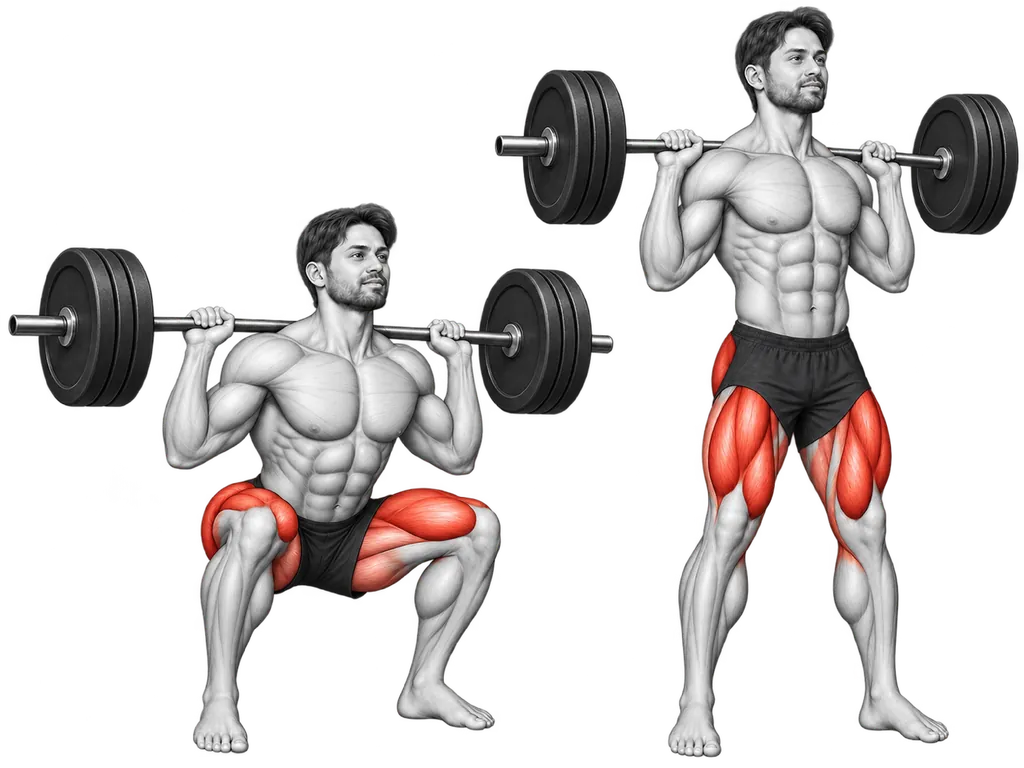
The squat is the lift people search for most, and the question is almost always depth. Short answer: go as deep as you can with your back holding the same shape throughout. Deeper than that is not better, it is a different exercise with a worse back position.
The squat is heavy and asks more of your technique than anything else in a leg session. It is also the lift that pays back most once the technique is there.
Sets, reps and RIR
A heavy multi-joint lift with free weights. Keep a rep or two in reserve on most sets so technique holds.
RIR means reps in reserve: how many you could still have done when you racked it. RIR 2 is two short of failure.
How to do it
- Rack the bar on your back, not your neck. High bar sits on the upper traps, low bar on the rear delts.
- Set your feet about shoulder width with the toes turned out slightly, and screw them into the floor.
- Breathe into the belly and brace before you start descending, not halfway down.
- Send the hips back and down while the knees track out over the toes.
- Descend until the hip crease is level with the knee or just below, as far as your back keeps its shape.
- Push the floor away and let the chest and hips rise at the same rate.
Common mistakes
- Hips shooting up first
- The rep has turned into a good morning with a bar on your back. Either the weight is too heavy or your quads are the weak link. Drop the load and keep the chest up the whole way.
- Knees caving in
- Most common right out of the hole. Think about spreading the floor apart with your feet. A light band around the knees makes the fault easy to feel.
- Heels lifting
- Usually ankle mobility rather than effort. Lifting shoes or a small plate under the heels fixes it immediately, and mobility work fixes it over time.
- Half depth with too much weight
- Four hundred kilos to the knee is not stronger than two hundred to depth. Pick a depth you can repeat, then log the same depth every time.
How it differs from the neighbouring variants
The front squat keeps the torso more upright and shifts work from the glutes to the quads. Most people lift 15 to 25 percent less on it, and technique stops the set before the legs do.
The leg press lets you go heavy without your midsection being the limit, which makes it the obvious pick when your back is still tired from deadlifts. The Smith machine squat gives you a fixed path, easier to learn, but it will not let you adjust your balance mid-rep the way a free bar does.
What it suits
The squat goes first in a leg session, while your head and your brace are fresh. If you are new to it, start with the goblet squat until the movement is there. If your lower back is sore, the leg press and the Bulgarian split squat train legs hard without loading it.
Muscles worked
Primary: Quads, Glutes.
Secondary: Lower back, Adductors, Abductors.
Estimate your one-rep max
Epley's formula, from a set you have actually done. It is an estimate, and it drifts above eight reps, so keep the input between one and twelve.
Enter a set to see the estimate.
What it is called elsewhere
- Norsk Knebøy (stang)
- Svenska Knäböj (skivstång)
- Dansk Squat (vægtstang)
- Deutsch Kniebeuge (Langhantel)
- Español Sentadilla (barra)
- Italiano Squat (bilanciere)
- Português Agachamento (barra)
- Русский Приседания со штангой
- Français Squat (barre)
Related legs exercises
- Goblet squat
- Bulgarian split squat
- Lunges (dumbbells)
- Walking lunges
- Step-ups
- Single-leg Romanian deadlift
athlate logs this exercise, keeps the numbers, and tells you what you lifted last time.