Exercise library / Legs
Hip thrust (barbell)
Legs · Barbell
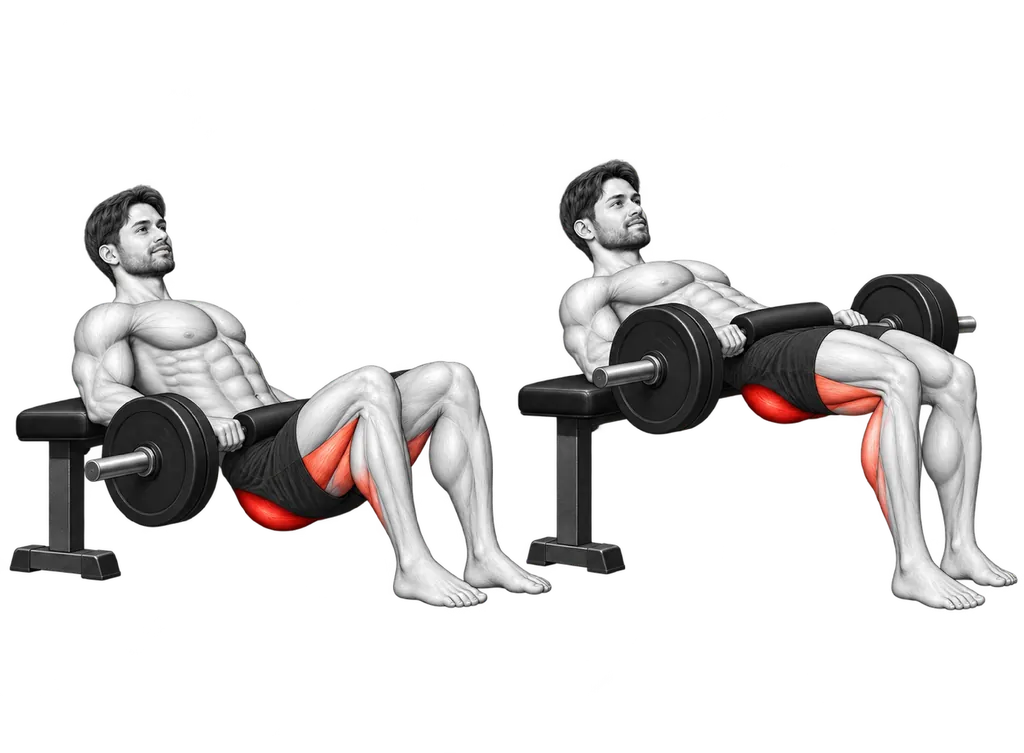
The hip thrust loads the glutes hardest in the position where they are strongest. Squats and deadlifts train the glutes too, but they give most resistance at the bottom. The hip thrust gives most at the top, with the hip straight.
That makes it an addition, not a replacement. It is also one of the few heavy lifts where setting up takes longer than the set itself.
Sets, reps and RIR
A heavy multi-joint lift with free weights. Keep a rep or two in reserve on most sets so technique holds.
RIR means reps in reserve: how many you could still have done when you racked it. RIR 2 is two short of failure.
How to do it
- Set your shoulder blades against the edge of a bench about forty centimetres high.
- Roll the bar over your hips with a pad underneath, and place your feet so your shins are vertical when the hip is straight.
- Tuck the chin slightly and look forward, not at the ceiling.
- Drive the hips up by squeezing the glutes, not by arching the lower back.
- Stop when your body is straight from knee to shoulder, and hold for a moment.
- Lower under control until the weight just touches the floor, then press again.
Common mistakes
- Feeling it in your lower back
- The extension is coming from your spine rather than your hip. Pull the ribs down, keep the chin tucked, and stop where the hip is straight instead of pushing further.
- Feet too far forward or back
- Too far forward makes it a hamstring exercise, too far back moves it to the quads. The shin should be vertical at the top.
- Bench too high
- If the bench sits above your shoulder blades at the top, you lose range and cannot finish the squeeze. Around forty centimetres suits most people.
- Half a hip extension
- Not reaching the top means skipping the part the lift exists for. Drop the weight until you can lock the hip out with a half-second pause.
How it differs from the neighbouring variants
The bodyweight glute bridge is the same movement from the floor, with a shorter range and no bar. It is where to learn the pattern and a good warm-up set.
The single-leg hip thrust removes the need for a heavy bar entirely and exposes side-to-side differences you cannot see with both legs. The Romanian deadlift trains the glutes stretched rather than shortened, and the two together cover the whole working range.
What it suits
The hip thrust belongs after squats or deadlifts, once the heavy multi- joint work is done. It tolerates higher reps than most barbell lifts, and eight to twelve with a pause at the top usually gives more than heavy triples.
Muscles worked
Primary: Glutes.
Secondary: Hamstrings, Quads, Abductors.
Estimate your one-rep max
Epley's formula, from a set you have actually done. It is an estimate, and it drifts above eight reps, so keep the input between one and twelve.
Enter a set to see the estimate.
What it is called elsewhere
- Norsk Hip thrust (stang)
- Svenska Hip thrust (skivstång)
- Dansk Hip thrust (vægtstang)
- Deutsch Hip Thrust (Langhantel)
- Español Hip thrust (barra)
- Italiano Hip thrust (bilanciere)
- Português Elevação pélvica (barra)
- Русский Ягодичный мостик со штангой
- Français Hip thrust (barre)
Related legs exercises
- Goblet squat
- Bulgarian split squat
- Lunges (dumbbells)
- Walking lunges
- Step-ups
- Single-leg Romanian deadlift
athlate logs this exercise, keeps the numbers, and tells you what you lifted last time.