Exercise library / Shoulders
Overhead press (barbell)
Shoulders · Barbell
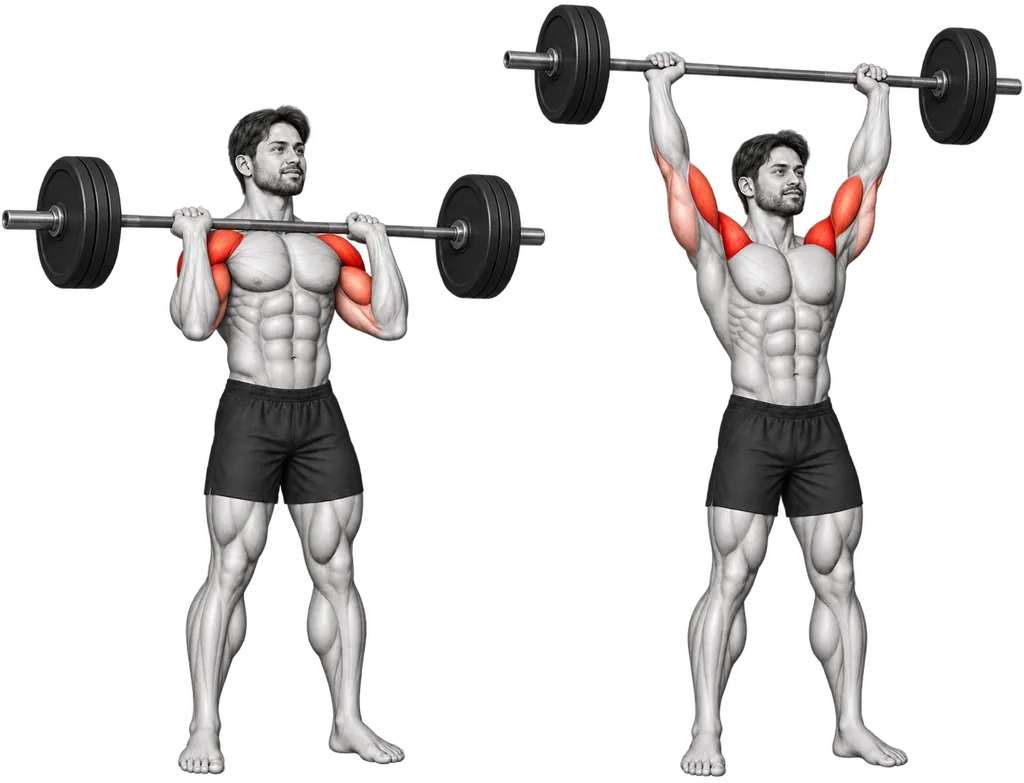
The standing overhead press is the most honest pressing lift there is. There is no bench to press against and no legs to drive with, so the weight on the bar is the weight your shoulders actually move.
It is also the easiest to cheat without noticing: a little arch in the lower back, a little dip in the knees, and it has quietly become a push press.
Sets, reps and RIR
Single-joint work responds to reps and time under tension more than to heavy load.
RIR means reps in reserve: how many you could still have done when you racked it. RIR 2 is two short of failure.
How to do it
- Take the bar from a rack at chest height, hands just outside shoulder width, elbows slightly in front of the bar.
- Stand with feet hip width, squeeze the glutes and brace, and keep the ribs down.
- Tuck the chin slightly so the bar has a clear path past your face.
- Press straight up, then push your head through your arms as soon as the bar clears your forehead.
- Lock out with the bar over the middle of your foot, not in front of it.
- Lower under control to chest height and hold the brace between reps.
Common mistakes
- Arching the lower back
- You have turned it into a standing incline press. Squeeze the glutes before you press, and drop the weight until the ribs stay down.
- Pressing around your head
- An arc forward costs force and loads the front of the shoulder. Chin in, bar straight up, head through afterwards.
- Dipping the knees
- Even a small dip makes it a push press, and then this week's numbers do not compare with last week's.
- Too heavy to lock out
- The overhead press is built on reps you finish. If you cannot straighten your arms, the weight is too high no matter how the first rep looked.
How it differs from the neighbouring variants
The seated barbell press takes the legs out of the equation and lets you go heavier, but the backrest removes some of the work your midsection was doing. The push press uses the legs on purpose, and is the lift when the goal is moving more weight overhead.
The dumbbell overhead press gives each shoulder its own path and is usually kinder if your shoulder grumbles, because the wrist can rotate freely. The machine shoulder press is where to put your last sets when you are tired and want volume without balancing anything.
What it suits
The standing press goes first in a shoulder session, or second after the bench press on a pushing day. If your upper back is stiff or your shoulders are tight, dumbbells or a landmine press will take you further than forcing a straight bar overhead.
Muscles worked
Primary: Front delts.
Secondary: Side delts, Triceps, Abs, Rotator cuff.
Estimate your one-rep max
Epley's formula, from a set you have actually done. It is an estimate, and it drifts above eight reps, so keep the input between one and twelve.
Enter a set to see the estimate.
What it is called elsewhere
- Norsk Skulderpress (stang)
- Svenska Militärpress (skivstång)
- Dansk Militærpres (vægtstang)
- Deutsch Schulterdrücken (Langhantel)
- Español Press militar (barra)
- Italiano Lento avanti (bilanciere)
- Português Desenvolvimento militar (barra)
- Русский Жим штанги стоя
- Français Développé militaire (barre)
Related shoulders exercises
- Overhead press (dumbbells)
- Arnold press
- Lateral raise (dumbbells)
- Front raise (dumbbells)
- Rear delt flyes
- Seated lateral raise
athlate logs this exercise, keeps the numbers, and tells you what you lifted last time.