Exercise library / Shoulders
Rear delt flyes
Shoulders · Dumbbells
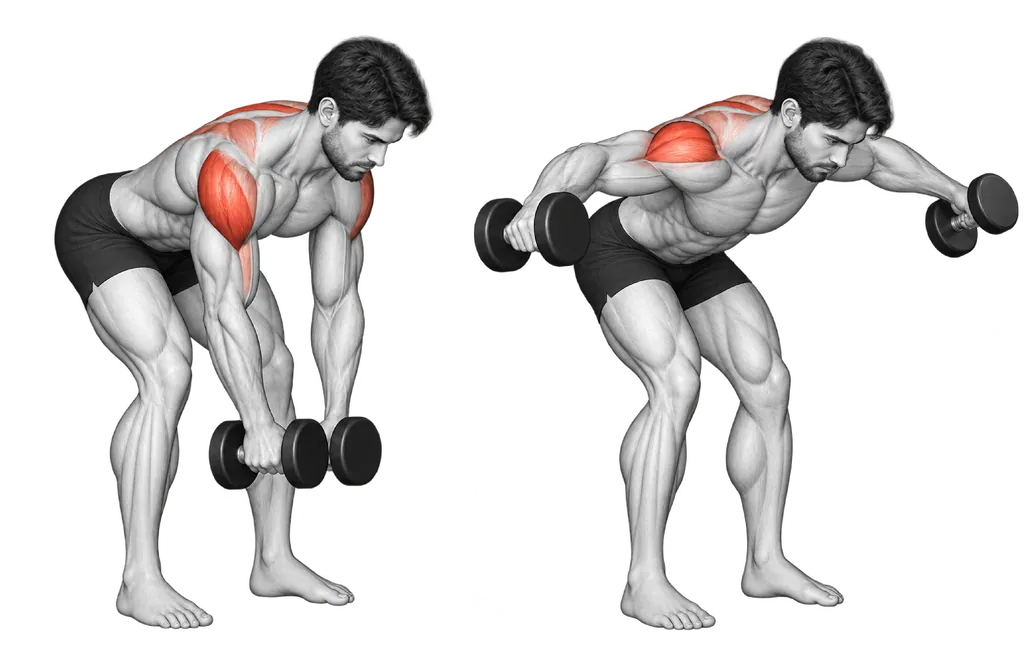
Rear delt flyes train the back of the shoulder, with help from the middle traps and rhomboids. It is a small muscle with a short range and almost no mechanical advantage.
That is why this is the exercise most often ruined by weight. The rear delt cannot move much, so the moment the dumbbells get heavy, the whole back starts helping and the target muscle gets a rest.
Sets, reps and RIR
Single-joint work responds to reps and time under tension more than to heavy load.
RIR means reps in reserve: how many you could still have done when you racked it. RIR 2 is two short of failure.
How to do it
- Hinge forward at the hips until your upper body is close to parallel with the floor, or lie chest-down on an incline bench.
- Let the dumbbells hang straight below your shoulders with a small bend in the elbows.
- Lift the arms out to the sides in a wide arc, leading with the elbows rather than the hands.
- Stop when the upper arms are level with your back. Going higher brings in the traps without adding anything for the delt.
- Lower slowly all the way back down, and start the next rep without swinging.
Common mistakes
- Using the whole back
- If the torso rises as the arms do, the set has become a row done badly. The upper body stays where it started from first rep to last.
- Shrugging at the top
- Shoulders climbing towards the ears means the traps have taken the work. Keep the shoulder blades low and let the arm do the lifting.
- Standing too upright
- From a standing position the load is on the side delt, not the rear one. The chest needs to be over the floor for the line of pull to be right.
- Picking weights you can barely control
- Rear delt work lives at the light end. Most people do their best sets with dumbbells they would be embarrassed to be seen holding.
How it differs from the neighbouring variants
The reverse pec deck does the same job with your chest against a pad, which removes the temptation to swing entirely. It is the more reliable version for most people.
Face pulls add external rotation on top of the fly, so they train the rotator cuff as well. They cover more of the shoulder and load the rear delt itself slightly less directly.
What it suits
Rear delt work fits at the end of a pull or shoulder session, and it recovers fast enough to run two or three times a week. Twelve to twenty-five reps, zero to two in reserve. If you press a lot and pull little, this is usually the first thing worth adding.
Muscles worked
Primary: Rear delts.
Secondary: Upper back, Traps.
Estimate your one-rep max
Epley's formula, from a set you have actually done. It is an estimate, and it drifts above eight reps, so keep the input between one and twelve.
Enter a set to see the estimate.
What it is called elsewhere
- Norsk Rear delt flyes
- Svenska Omvända flyes
- Dansk Omvendte flyes
- Deutsch Reverse Flys (Kurzhanteln)
- Español Elevaciones posteriores (mancuernas)
- Italiano Alzate posteriori (manubri)
- Português Crucifixo inverso (halteres)
- Русский Разведение гантелей в наклоне
- Français Oiseau (haltères)
Related shoulders exercises
- Overhead press (barbell)
- Seated overhead press (barbell)
- Push press
- Upright row (barbell)
- Landmine shoulder press
- Face pulls (cable)
athlate logs this exercise, keeps the numbers, and tells you what you lifted last time.