Exercise library / Shoulders
Lateral raise (dumbbells)
Shoulders · Dumbbells
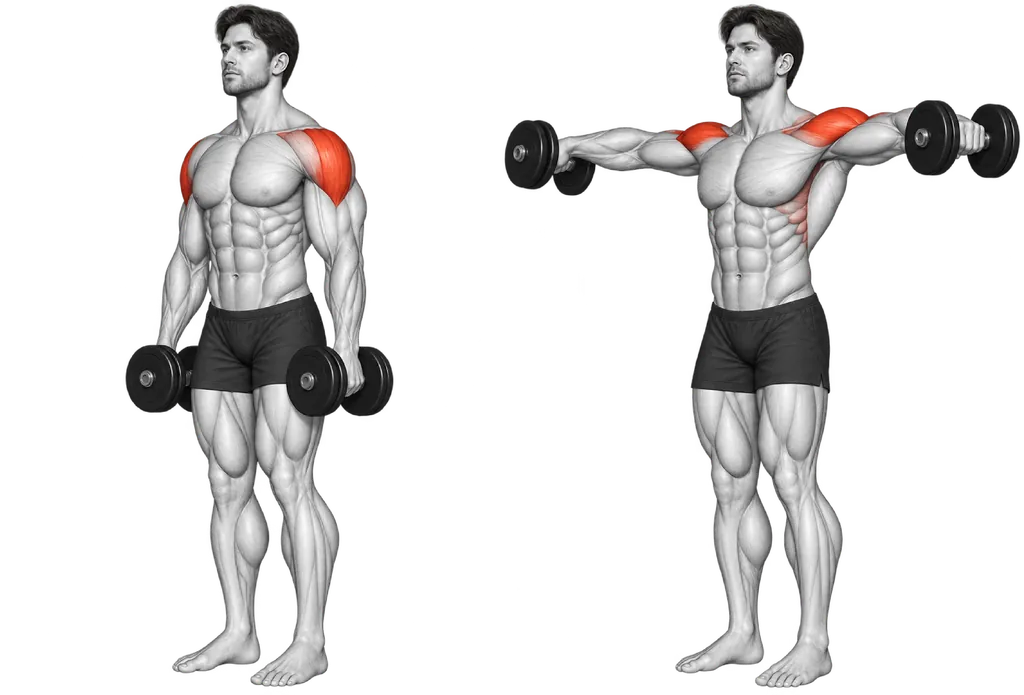
The lateral raise is where ego costs most. The middle delt is a small muscle on a long lever, and it never gets strong enough to swing heavy dumbbells cleanly.
It is also the exercise that shapes the shoulder more than any other. Width comes from the middle delt, and this is very nearly the only place you hit it.
Sets, reps and RIR
Single-joint work responds to reps and time under tension more than to heavy load.
RIR means reps in reserve: how many you could still have done when you racked it. RIR 2 is two short of failure.
How to do it
- Stand with the dumbbells at your sides and a slight bend in the elbows.
- Lean the torso a couple of degrees forward so the arm moves in the plane of the shoulder blade rather than straight out to the side.
- Raise out to the sides until the upper arm is about shoulder height.
- Think about lifting with the elbow, not the hand. The elbow leads all the way.
- Stop at shoulder height. Above that the traps take over.
- Lower under control over two to three seconds. The way down is half the exercise.
Common mistakes
- Too much weight
- The tell is dipping the knees and throwing the dumbbells up. Halve the load and you will feel more in the shoulder, not less.
- Shoulders shrugging up
- The traps have taken over. Pull the shoulders down and hold them there before you lift.
- Raising above shoulder height
- Past horizontal the shoulder blade rotates and the work moves upward. Not dangerous, but no longer a lateral raise.
- Dropping the weight
- Letting the dumbbells fall skips half the set. Count three on the way down.
How it differs from the neighbouring variants
The cable lateral raise gives even resistance throughout, including at the bottom where a dumbbell gives almost nothing. It is the better version if you only pick one.
The machine removes all balancing and lets you work closer to failure safely, which is useful at the end of a session. The seated raise removes the option of cheating with your legs and reveals how light you actually need to go. A band gives most resistance at the top, where the dumbbell is also hardest, so the two do not complement each other especially well.
What it suits
Lateral raises fit late in a shoulder session, after the pressing, and tolerate high volume. Twelve to twenty reps with a controlled descent gives more than six heavy ones. It is also one of the few exercises where two or three sessions a week beat one.
Muscles worked
Primary: Side delts.
Secondary: Traps.
Estimate your one-rep max
Epley's formula, from a set you have actually done. It is an estimate, and it drifts above eight reps, so keep the input between one and twelve.
Enter a set to see the estimate.
What it is called elsewhere
- Norsk Sidehev (hantler)
- Svenska Sidolyft (hantlar)
- Dansk Sidehæv (håndvægte)
- Deutsch Seitheben (Kurzhanteln)
- Español Elevaciones laterales (mancuernas)
- Italiano Alzate laterali (manubri)
- Português Elevação lateral (halteres)
- Русский Махи гантелями в стороны
- Français Élévations latérales (haltères)
Related shoulders exercises
- Overhead press (barbell)
- Seated overhead press (barbell)
- Push press
- Upright row (barbell)
- Landmine shoulder press
- Face pulls (cable)
athlate logs this exercise, keeps the numbers, and tells you what you lifted last time.