Exercise library / Chest
Bench press (barbell)
Chest · Barbell
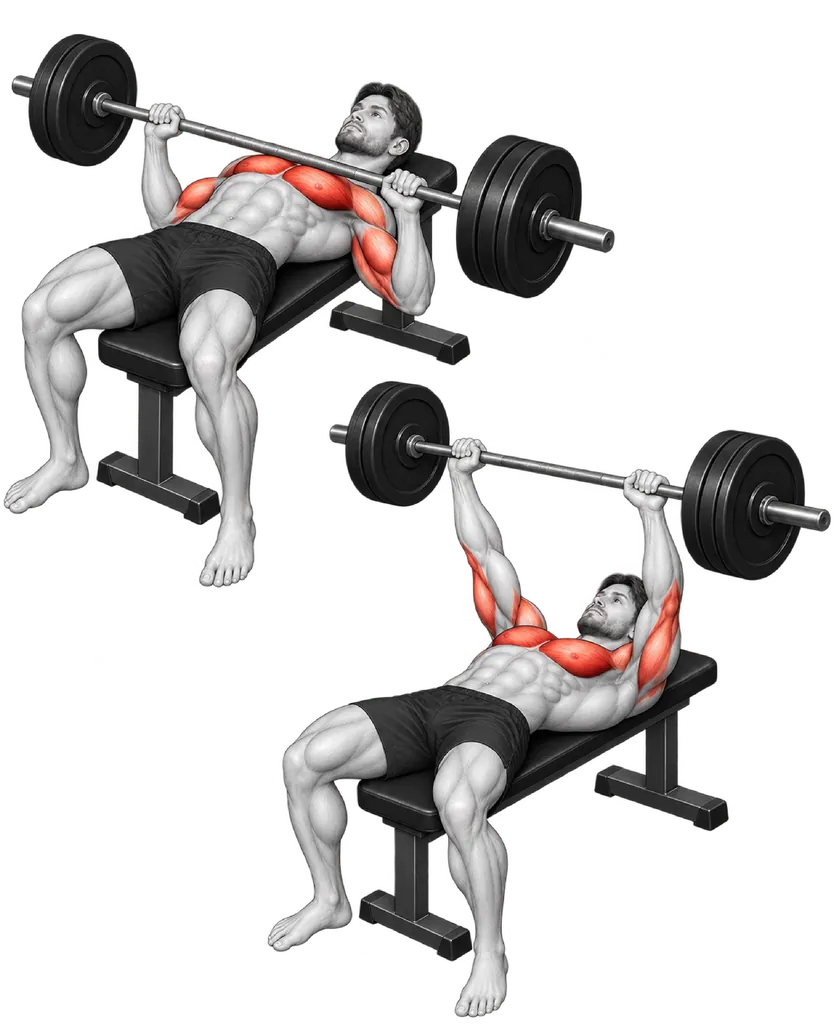
The barbell bench press is the most logged upper-body lift in athlate, and the one most people get slightly wrong. Not because the technique is hard, but because the bar hides how much the shoulders take over once the chest tires.
It is a heavy multi-joint lift. It tolerates low reps and high load, but it punishes sloppiness harder than a machine does, because nothing holds the path for you.
Sets, reps and RIR
A heavy multi-joint lift with free weights. Keep a rep or two in reserve on most sets so technique holds.
RIR means reps in reserve: how many you could still have done when you racked it. RIR 2 is two short of failure.
How to do it
- Lie so your eyes sit directly under the bar, and plant your feet wide enough that you can press against the floor.
- Pull your shoulder blades together and down towards your hips. The rib cage stays high for the whole set.
- Grip slightly wider than shoulder width, wrist stacked over the elbow rather than bent back.
- Unrack with straight arms and lower under control to the lower chest, elbows around 45 to 60 degrees out from the body.
- Touch the chest without bouncing, then press the bar back in a slight arc towards the shoulder joint.
- Lock out without losing the shoulder blade position. The next rep starts with the rib cage still high.
Common mistakes
- Elbows flared straight out
- Ninety degrees from the body loads the front of the shoulder and ends the set long before the chest is done. Tuck the elbows in a little.
- Hips leaving the bench
- That turns the lift into a decline press you cannot repeat the same way next week. Move your feet in and lift the rib cage instead.
- Bouncing the bar off the chest
- You borrow a few kilos from your ribs and skip the part of the range that actually builds. Stop the bar, pause, press.
- Shorter reps as the weight climbs
- The log shows progress and the chest feels nothing. Weight only counts if the reps look the same from the first set to the last.
How it differs from the neighbouring variants
The incline barbell press moves part of the work to the upper chest and front delt, and most people lift 10 to 20 percent less on it. The flat dumbbell press gives a longer range and makes each arm work on its own, but the ceiling on load is lower.
The close-grip bench press is almost the same lift with the elbows tucked, which makes it more triceps than chest. If the bottom position hurts your shoulder, dumbbells or a chest press machine are usually what let you keep training instead of taking time off.
What it suits
Bench press belongs early in an upper-body session, while you are fresh and can go heavy. If you train alone without a spotter or safety arms, dumbbells or a machine are a safer way to get the same work done.
Muscles worked
Primary: Chest.
Secondary: Front delts, Triceps, Rotator cuff.
Estimate your one-rep max
Epley's formula, from a set you have actually done. It is an estimate, and it drifts above eight reps, so keep the input between one and twelve.
Enter a set to see the estimate.
What it is called elsewhere
- Norsk Benkpress (stang)
- Svenska Bänkpress (skivstång)
- Dansk Bænkpres (vægtstang)
- Deutsch Bankdrücken (Langhantel)
- Español Press de banca (barra)
- Italiano Panca piana (bilanciere)
- Português Supino reto (barra)
- Русский Жим штанги лёжа
- Français Développé couché (barre)
Related chest exercises
- Flat dumbbell press
- Incline dumbbell press
- Dumbbell flyes
- Incline dumbbell flyes
- Dumbbell pullover (chest)
- Decline dumbbell press
athlate logs this exercise, keeps the numbers, and tells you what you lifted last time.