Exercise library / Legs
Wall sit
Legs · Bodyweight
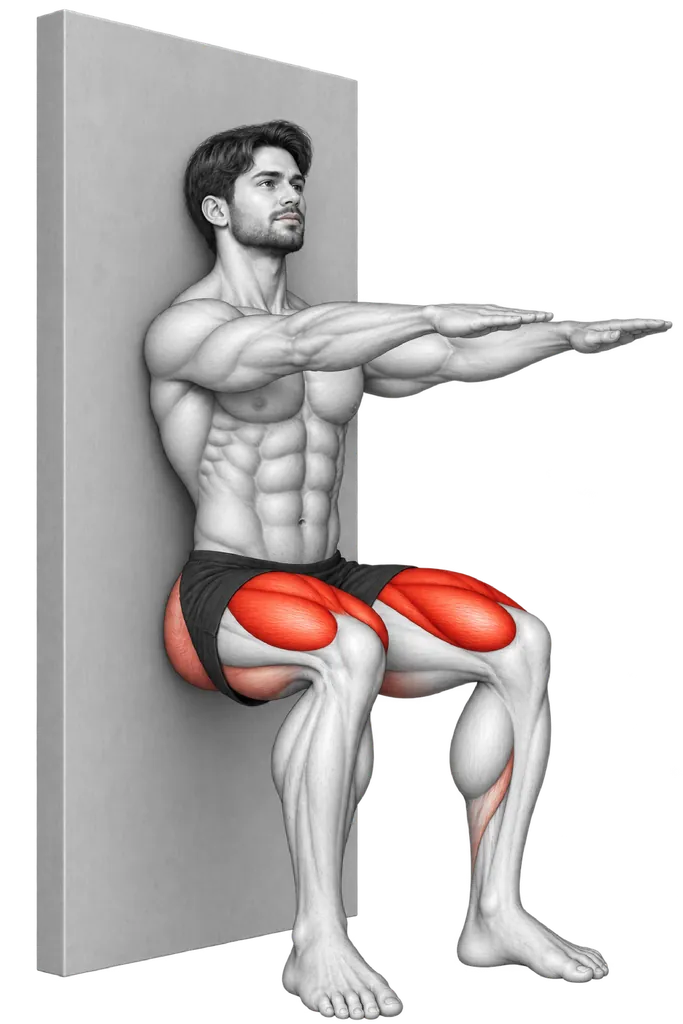
The wall sit is an isometric exercise: you hold the squat position against a wall. It loads the quadriceps for as long as you can stay.
It needs no equipment and is easy to measure in seconds, so it works well as a way to see progress.
Sets, reps and RIR
Load is fixed, so progress by adding reps first, then by slowing the lowering phase, then by adding weight.
RIR means reps in reserve: how many you could still have done when you racked it. RIR 2 is two short of failure.
How to do it
- Stand with your back against a wall and walk the feet forward about a stride.
- Slide down until the thighs are parallel to the floor, with the knees above the ankles.
- Keep the whole back against the wall and the arms hanging, not on the knees.
- Hold for 30 to 60 seconds. Breathe calmly.
- Stand up slowly, rest, and repeat two to three times.
Common mistakes
- Knees too far forward
- If the knees pass the toes, move the feet further out from the wall until the shins are vertical.
- Hands on the thighs
- Pushing on the thighs takes the work off the legs. Let the arms hang or fold them.
- Sitting too high
- Half-way up is easier but trains less. Aim for thighs parallel to the floor.
How it differs from the neighbouring variants
A squat loads the same muscles with movement and weight, and lets you get stronger faster. The wall sit gives a simple time target and almost no technique to learn.
A leg press can be loaded heavily. The wall sit is a good finisher after either.
What it suits
It suits you as a finisher after leg work, as a first leg exercise if you are returning to training, or to measure endurance in the thighs over time.
Muscles worked
Primary: Quads.
Secondary: Glutes.
What it is called elsewhere
- Norsk Veggsitt
- Svenska Jägarvila
- Dansk Wall sit
- Deutsch Wandsitzen
- Español Sentadilla isométrica en pared
- Italiano Wall sit
- Português Cadeirinha na parede
- Русский Стульчик у стены
- Français Chaise contre le mur
Related legs exercises
athlate logs this exercise, keeps the numbers, and tells you what you lifted last time.