Exercise library / Core
Plank
Core · Bodyweight
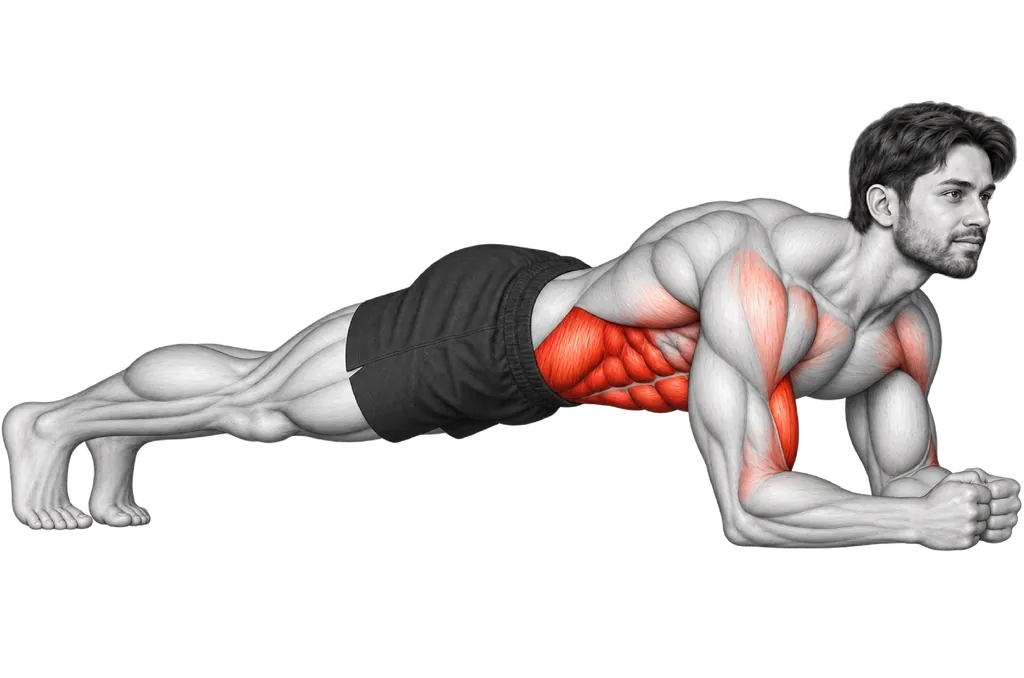
The plank is the most misunderstood core exercise there is. People compete on time, but time is not what it measures. A plank tests whether you can keep your ribs down and your pelvis level while something pulls them out of position.
If you can hold two minutes, the answer is not three. It is time to make the exercise harder, not longer.
Sets, reps and RIR
Load is fixed, so progress by adding reps first, then by slowing the lowering phase, then by adding weight.
RIR means reps in reserve: how many you could still have done when you racked it. RIR 2 is two short of failure.
How to do it
- Set up on your forearms with the elbows directly under the shoulders.
- Put your toes down and lift into one straight line from head to heel.
- Pull the ribs down towards the hips and brace as if expecting a punch.
- Squeeze the glutes. That is what stops the lower back arching.
- Press the forearms into the floor and push the shoulder blades apart.
- Breathe calmly. If you cannot breathe, you are bracing too hard to learn anything.
Common mistakes
- Hips sagging
- The lower back has taken the job from the abs. This is where plank-induced back pain comes from. End the set there, not when the clock says so.
- Hips in the air
- The opposite fault. Easier, but no longer a plank.
- Holding your breath
- Bearing down is not the same as bracing. You should be able to talk, just about.
- Chasing time
- Past roughly sixty seconds you are testing endurance in an isometric position, not stability. Move to a harder variation.
How it differs from the neighbouring variants
The side plank takes the same job sideways and reaches the obliques and the hip. The two together cover more than a plank alone at twice the duration.
Dead bug and bird dog apply the same principle with movement: you hold the midsection still while arms and legs travel. The ab wheel is a plank on a much longer lever, and is the natural next step once planks feel easy. The hollow hold is the same brace from your back, with even less help from the floor.
What it suits
The plank fits as a warm-up before heavy lifting, or at the end of a session. Three sets of thirty to sixty seconds with perfect position is enough. To make it harder, lift a foot, put a plate on your back, or move to the ab wheel.
Muscles worked
Primary: Abs.
Secondary: Obliques, Front delts, Glutes.
What it is called elsewhere
- Norsk Planke
- Svenska Plankan
- Dansk Planke
- Deutsch Unterarmstütz
- Español Plancha
- Italiano Plank
- Português Prancha
- Русский Планка
- Français Planche
Related core exercises
athlate logs this exercise, keeps the numbers, and tells you what you lifted last time.