Exercise library / Core
Hanging leg raise
Core · Bodyweight
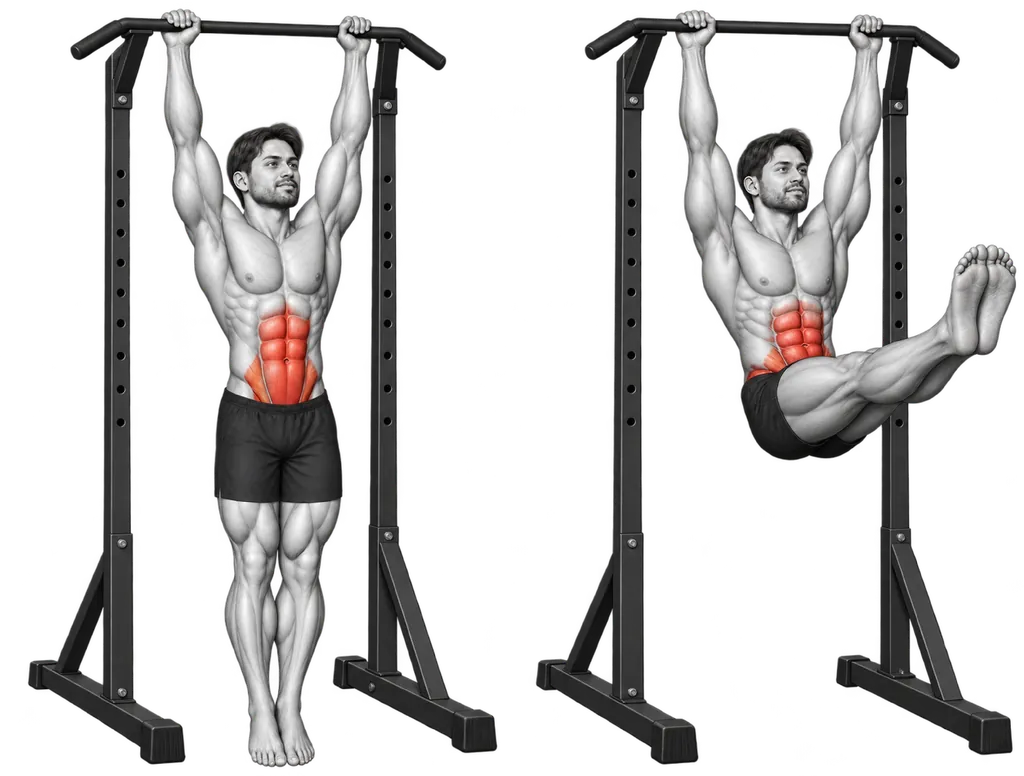
The hanging leg raise looks like it trains the abs and often does not. Lifting straight legs to hip height is mostly hip flexors. The abs only take over when the pelvis tilts back and the lower back flattens.
That means the last part of the rep is the exercise, and the first part is the price of admission.
Sets, reps and RIR
Load is fixed, so progress by adding reps first, then by slowing the lowering phase, then by adding weight.
RIR means reps in reserve: how many you could still have done when you racked it. RIR 2 is two short of failure.
How to do it
- Hang from a bar with a shoulder width grip, arms straight, shoulders pulled down away from the ears.
- Tighten the midsection so you stop swinging before the first rep.
- Lift the legs with the knees bent or straight, depending on what you can control.
- Once the thighs pass parallel, curl the pelvis up towards the ribs. This is the part that trains the abs.
- Lower slowly, keeping the ribs down, and stop the swing before the next rep.
Common mistakes
- Swinging
- Momentum does the work and the shoulders take the strain. If you cannot stop between reps, do fewer reps.
- Stopping at hip height
- Legs to parallel without the pelvic tilt is a hip flexor exercise. Curl the pelvis or the abs never get involved.
- Starting with straight legs
- Straight legs are a longer lever, not a better exercise. Bent knees first, straighten them as control improves.
- Grip failing before the abs
- That is a grip problem, not an ab problem. Use straps, or move to a captain's chair, so the set ends for the right reason.
How it differs from the neighbouring variants
The lying leg raise removes the grip and the swing, which makes it easier to reach the pelvic tilt. It is the sensible place to start.
The cable crunch trains the same flexion with the load on a stack, so it is easy to progress in small steps. Toes to bar is the hanging version taken to full range, and belongs to gymnastics more than to a training log.
What it suits
Hanging leg raises go at the end of a session, or between sets of something heavy. Eight to fifteen reps with the pelvic tilt on every one. When that gets easy, straighten the legs before you add weight between the feet.
Muscles worked
Primary: Abs, Hip flexors.
Secondary: Forearms, Obliques.
What it is called elsewhere
- Norsk Hengende benhev
- Svenska Hängande benlyft
- Dansk Hængende benløft
- Deutsch Hängendes Beinheben
- Español Elevación de piernas colgado
- Italiano Sollevamento gambe alla sbarra
- Português Elevação de pernas na barra
- Русский Подъём ног в висе
- Français Relevé de jambes suspendu
Related core exercises
athlate logs this exercise, keeps the numbers, and tells you what you lifted last time.