Exercise library / Chest
Cable crossover
Chest · Cable
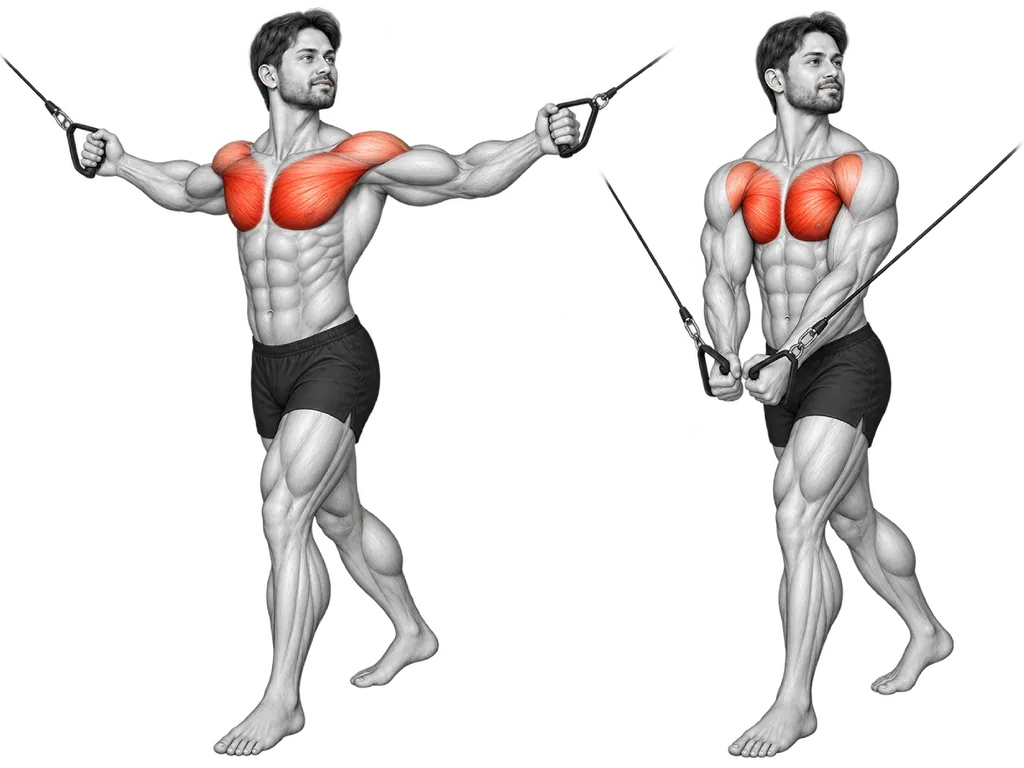
The cable crossover is a chest fly done against a cable instead of gravity. The line of pull comes from the side the whole way, so the chest is loaded at the top of the movement as well, where a dumbbell fly goes almost weightless.
It is an adduction exercise: the arms travel across the body rather than pressing away from it. That is the job the chest is built for, and it is the part a bench press never fully trains.
Sets, reps and RIR
Machines and cables hold the path for you, so you can work closer to failure than with free weights.
RIR means reps in reserve: how many you could still have done when you racked it. RIR 2 is two short of failure.
How to do it
- Set both pulleys and step forward until the cables are taut with your arms out to the sides.
- Stagger your feet. One foot forward gives you something to brace against so the weight does not pull you backwards.
- Bend the elbows slightly and lock that angle. It stays the same for the whole set.
- Bring the handles together in front of you along an arc, and let the hands meet or cross.
- Return under control until you feel the chest stretch, without letting the shoulders roll forward.
Common mistakes
- Pressing instead of flying
- If the elbows straighten on the way in, the triceps have taken over and the chest is doing less. The elbow angle you started with is the angle you finish with.
- Loading it like a press
- Too much weight and the arms straighten on their own. This is an exercise where the weight on the stack is the least interesting number in the set.
- Letting the shoulders roll forward
- At the end of the stretch the shoulder can slide forward and take the load off the chest and onto the joint. Keep the chest up and the shoulder blades set.
- Stopping when the hands are level
- The chest keeps working past that point. Let the hands meet, or cross them, and the last part of the range gets trained too.
How it differs from the neighbouring variants
The pec deck does the same movement on a fixed path with your back supported. It is easier to load, easier to take close to failure, and it asks nothing of your balance. The crossover asks more of you and lets you pick the angle.
High pulleys pulling down and in load the lower chest hardest. Low pulleys pulling up and in shift the work towards the upper chest. Setting them at shoulder height sits between the two.
What it suits
Crossovers belong at the end of a chest session, after the pressing, where the point is to work the muscle rather than move a big number. Ten to twenty reps suits the constant tension, and one or two reps in reserve is enough. Nothing here is limited by your lower back or your nerve, so the last few reps are safe to take.
Muscles worked
Primary: Chest.
Secondary: Front delts.
Estimate your one-rep max
Epley's formula, from a set you have actually done. It is an estimate, and it drifts above eight reps, so keep the input between one and twelve.
Enter a set to see the estimate.
What it is called elsewhere
- Norsk Kabel crossover
- Svenska Cable crossover
- Dansk Kabel crossover
- Deutsch Cable Crossover
- Español Cruce de poleas
- Italiano Croci ai cavi
- Português Crossover (polia)
- Русский Сведение рук в кроссовере
- Français Écarté à la poulie vis-à-vis
Related chest exercises
- Bench press (barbell)
- Incline bench press (barbell)
- Decline bench press (barbell)
- Close-grip bench press (barbell)
- Landmine press
- Flat dumbbell press
athlate logs this exercise, keeps the numbers, and tells you what you lifted last time.