Exercise library / Arms
Hammer curl
Arms · Dumbbells
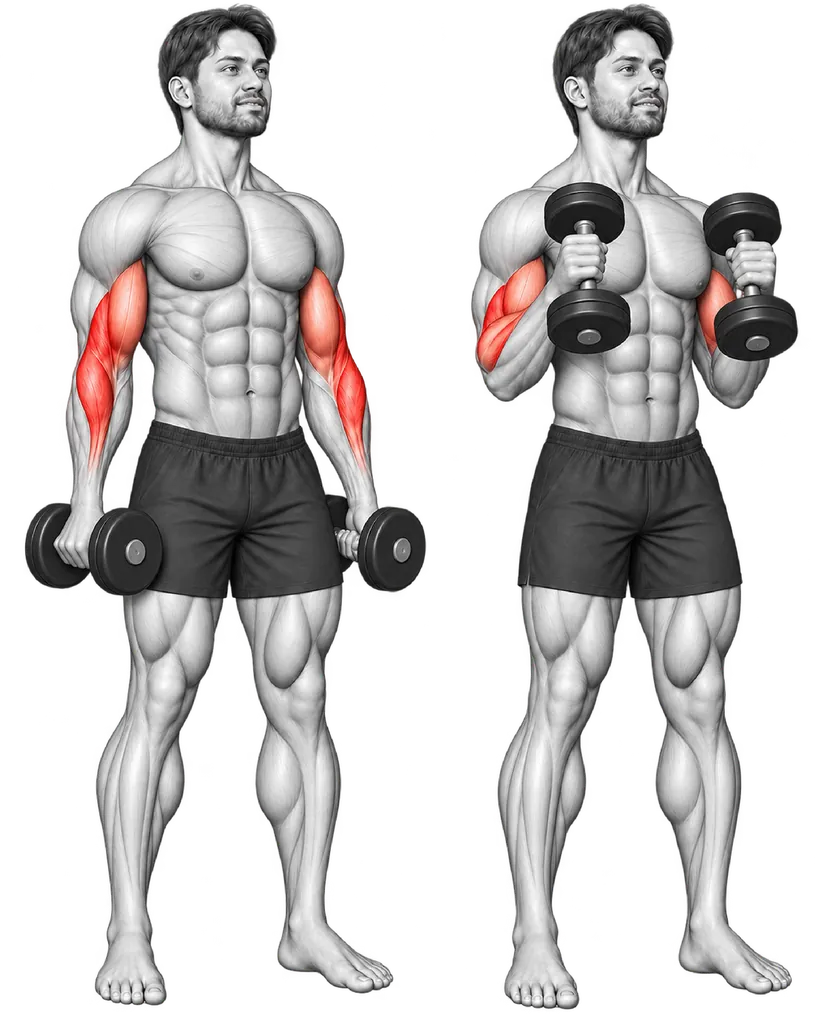
The hammer curl is the same movement as a biceps curl with the palms turned in. That one change moves a large part of the work to the brachialis, which sits under the biceps, and to the brachioradialis in the forearm.
It is usually the curl people can load heaviest, because the neutral grip is stronger and the wrist is in a more comfortable position. That is also why it is the easiest curl to cheat.
Sets, reps and RIR
Single-joint work responds to reps and time under tension more than to heavy load.
RIR means reps in reserve: how many you could still have done when you racked it. RIR 2 is two short of failure.
How to do it
- Stand with a dumbbell in each hand, palms facing your thighs, arms hanging straight.
- Pin your upper arms against your ribs. They stay there for the whole set.
- Curl the weight up without rotating the wrist. The palms face each other from start to finish.
- Stop when the forearm meets resistance from the upper arm, around shoulder height, without letting the elbow drift forward.
- Lower under control, all the way to straight arms. The bottom half is where the brachialis does most of its work.
Common mistakes
- Swinging from the hips
- The weight goes up, the arm does less. If you need the hips to start the rep, the dumbbells are too heavy for the job you picked them for.
- Elbows travelling forward
- Once the elbow moves in front of the ribs, the front delt takes over and the arm gets a break at the top. Keep the upper arm vertical.
- Stopping short at the bottom
- Half reps feel stronger and build less. Straighten the arm every rep, even if it costs you weight.
- Turning it into a wrist exercise
- Letting the wrist bend back under load puts the strain somewhere you did not intend. Wrist stacked over the forearm, knuckles pointing forward.
How it differs from the neighbouring variants
The regular dumbbell curl with the palm turned up puts more of the work on the biceps itself, and most people lift less on it. The reverse curl, palms down, is the same idea taken further towards the forearm, and the load drops again.
The rope hammer curl on a cable keeps tension on the muscle through the whole range, including the top, where dumbbells go light. The incline dumbbell curl does the opposite and loads the stretched position hardest.
What it suits
Hammer curls go at the end of an upper-body or arm session, after the pulling work. Eight to fifteen reps suits the movement, and one or two reps in reserve is enough, since nothing here is limited by your midsection or your nerve. If your elbows ache from pressing, the neutral grip is usually the curl you can keep doing.
Muscles worked
Primary: Biceps, Forearms.
Estimate your one-rep max
Epley's formula, from a set you have actually done. It is an estimate, and it drifts above eight reps, so keep the input between one and twelve.
Enter a set to see the estimate.
What it is called elsewhere
- Norsk Hammer curl
- Svenska Hammercurl
- Dansk Hammercurl
- Deutsch Hammercurl
- Español Curl martillo (mancuernas)
- Italiano Curl a martello
- Português Rosca martelo
- Русский Молотковые сгибания с гантелями
- Français Curl marteau
Related arms exercises
athlate logs this exercise, keeps the numbers, and tells you what you lifted last time.