Exercise library / Arms
Cable curl
Arms · Cable
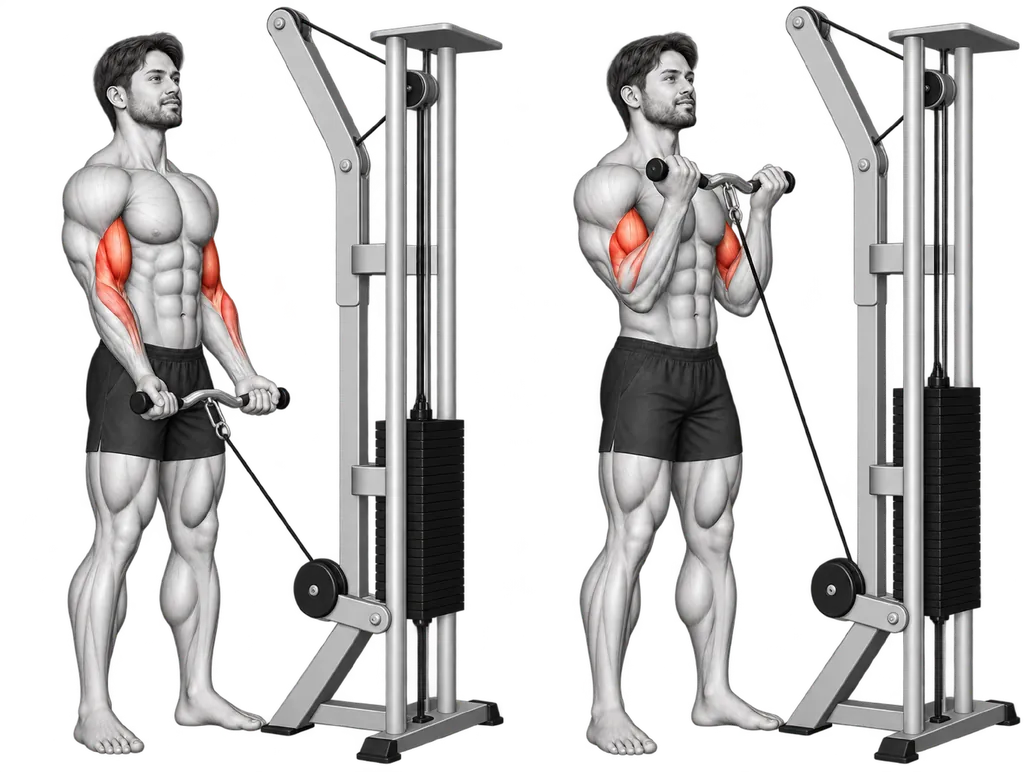
A cable curl keeps a constant line of pull on the biceps through the whole rep. A dumbbell curl goes light at the top, because the weight hangs below the elbow and the mechanical advantage disappears.
That makes the cable version the better choice when the goal is time under tension rather than a heavy number, and it is one of the few curls where the last few centimetres still cost you something.
Sets, reps and RIR
Single-joint work responds to reps and time under tension more than to heavy load.
RIR means reps in reserve: how many you could still have done when you racked it. RIR 2 is two short of failure.
How to do it
- Set the pulley at the bottom and take the bar or handle with an underhand grip.
- Step back until the cable is taut with your arms straight and your elbows at your sides.
- Curl up by bending the elbows only, keeping the upper arms still against your ribs.
- Bring the hands up until the forearms are just past vertical, where the cable is still pulling against you.
- Lower all the way to straight arms under control, without letting the weight stack take over.
Common mistakes
- Elbows drifting forward
- Letting the elbows rise turns the top of the curl into a front raise and hands the work to the shoulder.
- Standing in the wrong place
- Too close and the cable goes slack at the bottom. Too far and it pulls you off balance. Taut at straight arms is the right distance.
- Leaning back to finish the rep
- Rocking the torso backwards is the same cheat as a swinging barbell curl, just less obvious because the cable hides it.
- Short reps at the bottom
- The straight-arm position is where the cable has an advantage over free weights. Cutting it off gives that advantage away.
How it differs from the neighbouring variants
The dumbbell curl lets each arm work independently and is easier to load heavy, but the top of the rep is nearly free.
The preacher curl loads the stretched position hardest. Running a preacher and a cable curl in the same session covers both ends of the range.
What it suits
Cable curls work well as the last arm exercise, when the biceps is already tired and adding weight is not the point. Ten to twenty reps, zero to two in reserve. Because the tension never drops, the sets feel harder than the number on the stack suggests.
Muscles worked
Primary: Biceps.
Secondary: Forearms.
Estimate your one-rep max
Epley's formula, from a set you have actually done. It is an estimate, and it drifts above eight reps, so keep the input between one and twelve.
Enter a set to see the estimate.
What it is called elsewhere
- Norsk Kabelcurl
- Svenska Kabelcurl
- Dansk Kabelcurl
- Deutsch Bizepscurl am Kabel
- Español Curl en polea
- Italiano Curl ai cavi
- Português Rosca direta (polia)
- Русский Сгибание рук на нижнем блоке
- Français Curl à la poulie
Related arms exercises
athlate logs this exercise, keeps the numbers, and tells you what you lifted last time.